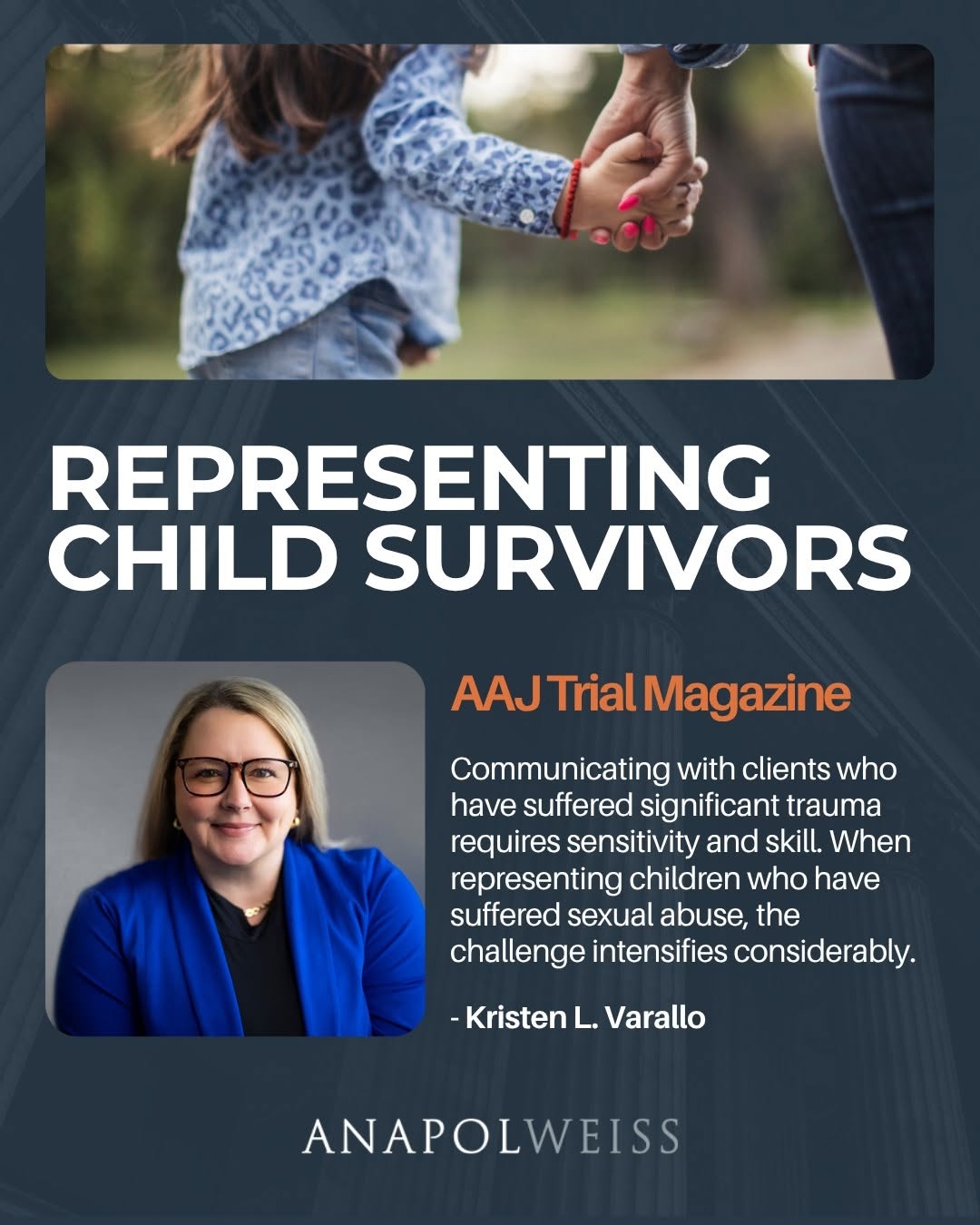
Anapol Weiss attorney Kristen L. Varallo was recently published in Trial magazine, the flagship publication of the American Association for Justice, for her article on representing child survivors of sexual abuse. In it, Varallo draws on her experience advocating for survivors across the nation to lay out a framework that every attorney working with child clients should understand. The article, featured in the June 2026 edition, is a resource for the legal community and a reflection of the values that guide the work at Anapol Weiss.
Representing child survivors of sexual abuse requires more than legal knowledge. It demands patience, empathy, and a trauma-informed approach that puts the child's comfort and safety at the center of everything you do. Below, we highlight the key tips Varallo shares in her published article and explain why each one matters for families navigating this process.
If your family needs the support of an experienced child sexual abuse attorney, call Anapol Weiss at 215-735-1130 or use our online contact form to schedule a free consultation.
Child Sexual Abuse Cases: What Makes This Representation Different From Other Civil Litigation?
Civil litigation generally follows a predictable structure. You gather evidence, depose witnesses, negotiate, and try the case if needed. But when your client is a child who has survived sexual abuse, every step of that process requires a different lens.
Children who have been abused often carry the weight of that trauma into every conversation, including conversations with their attorney. The power imbalance between adults and children makes them especially vulnerable to feeling unheard, dismissed, or overwhelmed. Add to that the growing number of cases involving online predation and grooming through platforms like Roblox, Discord, Snapchat, and other gaming and social media environments, and it becomes clear that attorneys handling these matters are working at the intersection of legal advocacy and trauma support.
Getting it right matters. The way you communicate with your child client will determine the strength of your attorney-client relationship, the quality of information you receive, and ultimately, the trajectory of the litigation itself.
Trauma's Impact On Child Clients: What Attorneys Need To Understand Before The First Meeting
Before you can effectively advocate for a child survivor of sexual abuse, you need to understand what trauma actually does to a child's mind and body. Many children who have been abused or sexually exploited struggle with depression, memory gaps, post-traumatic stress disorder, sleep disruption, and significant trust issues. These are not signs of unreliability or exaggeration. They are natural, well-documented responses to life-altering experiences.
Trauma affects how children process and recall events. A child may not be able to describe their experience in a linear, chronological way. They may shut down during difficult conversations or become easily overwhelmed. They may minimize what happened to them or, conversely, have a heightened emotional response when certain topics arise.
Understanding this context will inform how you approach every interaction, from how you structure your initial meeting to how you prepare the child for a deposition. Trauma-informed representation is not about lowering your legal standards. It is about adapting your approach so that your client can participate in the process as fully and safely as possible.
Creating A Safe Space: How The Meeting Environment Affects A Child Client's Willingness To Communicate
One of the most practical and impactful things you can do when representing a child survivor is to rethink the setting of your meetings. A formal conference room with a long table, overhead lighting, and unfamiliar adults can be deeply intimidating to anyone. For a child who has experienced trauma and a loss of safety, it can be paralyzing.
Instead, ask the child and their family where they would feel most comfortable meeting. That might be at their home, in a neighborhood park, at their school after hours, or at a favorite restaurant. If the setting allows it, invite them to bring a pet. Even meeting while doing a low-key activity they enjoy, like drawing or playing a simple game, can lower anxiety and open up communication.
Your appearance matters too. Dressing in business casual attire, as Varallo suggests in her Trial magazine article, sends the message that you are approachable. Think of it as dressing for coffee with a trusted friend rather than a board meeting. An overly formal appearance can create distance before a single word is spoken.
Building Trust With Child Clients: Communication Strategies That Make A Difference
Trust is not something you can establish in one meeting. It builds slowly, through consistent, honest, and warm interactions over time. Use plain language that is easy for the child to understand, and always maintain a tone that is calm and approachable.
Ask about things that matter to them. Their best friend, their pets, what they want to be when they grow up, or what they like to do after school. Share something about yourself as well. Show a picture of your pets or mention a hobby you enjoy, and invite them to share theirs. These small, genuine exchanges are what build the foundation of trust, and trust is what makes a child willing to share the things that are hardest to say.
Be thoughtful about the language you use when discussing the abuse. Avoid labels that reduce a child to their trauma. Words like victim or abused child define a person by the worst thing that ever happened to them. Similarly, well-meaning phrases like don't cry can silence a child who needs space to express what they feel. Acknowledge their emotions. Normalize them. Let the child know that whatever they are feeling is valid.
Encouraging Agency In Child Sexual Abuse Cases: Why Giving Children A Voice Matters
One of the most damaging effects of abuse is the loss of control. A child who has been exploited has had their agency taken from them. As their attorney, one of the most powerful things you can do is give some of that agency back.
Whenever possible, allow your child client to make choices. Ask whether they would prefer to talk by phone or in person. Ask whether they feel more comfortable with or without a parent present for certain conversations. Some children find it easier to write down details of what happened rather than speaking about them out loud. Offer that option and remain open to whatever form of communication works best for them.
These choices may seem small in the context of a complex legal matter. But for a child who has spent months or years feeling powerless, having even a limited sense of control can be deeply meaningful. It also signals that you see them as a whole person and not just a case file.
Explaining The Legal Process: Preparing A Child Client For Depositions, Hearings, And Trial
Children are not accustomed to legal proceedings, and without proper preparation, the process can feel confusing and frightening. Your job is to explain what lies ahead in language that is honest, age-appropriate, and reassuring.
Explain what a deposition is and why it happens. Describe what a courtroom looks like. Walk them through what a hearing involves, who will be in the room, and what they might be asked. Reassure them clearly and repeatedly that they are not in trouble. The purpose of the litigation is to hold the person who harmed them accountable, not to put the child on trial.
Let your client know that you will be with them every step of the way and that they will never face any part of this process alone. Check in with them regularly. Keep communication open between meetings. The more informed and supported a child feels, the more resilient and capable they will be when the stakes are highest.
Child Predation Cases: What Families Should Know
The rise of online platforms and virtual gaming environments has created new and alarming pathways for child predators. Families across the country are increasingly dealing with cases involving online grooming, sexual exploitation through apps and gaming platforms, and abuse facilitated by tech companies that failed to protect young users.
Anapol Weiss, located in Center City Philadelphia, has handled cases involving platforms like Roblox, Discord, and Snapchat, as well as rideshare companies like Uber and Lyft, where predatory conduct has harmed children and young adults. These cases require a trauma-informed, client-centered approach layered with a thorough understanding of platform liability and corporate negligence.
Families who are navigating these situations should not wait to seek legal guidance. The earlier you engage with an attorney who understands both the legal and human dimensions of these cases, the better positioned your family will be.
Attorney Well-Being In Child Sexual Abuse Cases: Protecting Yourself And Your Team
This work takes a toll. Attorneys who regularly handle child sexual abuse cases are at elevated risk for vicarious trauma and compassion fatigue, conditions that occur when absorbing the trauma of others begins to affect your own emotional and psychological health.
Varallo addresses this directly in her Trial magazine article: you cannot pour from an empty cup. Learning to identify the signs of vicarious trauma, both in yourself and in the members of your team, is not a luxury. It is a professional responsibility. Take breaks when you need them. Seek support. Build a practice culture that acknowledges the emotional weight of this work and gives people space to address it honestly.
When you are well, you show up better for your clients. For children who have already experienced profound harm from adults in their lives, having an attorney who is grounded, present, and genuinely engaged can be one of the most stabilizing relationships they have during a deeply difficult time.
Frequently Asked Questions About Representing Child Survivors Of Sexual Abuse
What does trauma-informed representation mean for child sexual abuse attorneys?
Trauma-informed representation means understanding how trauma affects a child's memory, communication, and behavior, and adjusting your approach accordingly. It involves creating safe environments, using careful and empowering language, building trust gradually, and giving the child agency throughout the legal process.
How should a child sexual abuse attorney approach the first meeting with a minor client?
The first meeting should take place somewhere the child feels comfortable, which may not be a law office. Ask about their preferences, dress in a relaxed and approachable way, and focus on building genuine connection before discussing the legal matter. Trust is the foundation of everything that follows.
Can a child choose how they communicate with their attorney in a sexual abuse case?
Yes, and offering those choices is an important part of trauma-informed legal representation. Options such as writing versus speaking, phone versus in-person communication, or meeting with or without a parent help restore a sense of agency that abuse often removes.
What types of child sexual abuse and online predation cases does Anapol Weiss handle?
Anapol Weiss represents families in cases involving online grooming, sexual exploitation through gaming and social media platforms like Roblox, Discord, and Snapchat, and sexual assault facilitated by rideshare companies like Uber and Lyft. Attorney Kristen L. Varallo focuses on these and related cases throughout the nation.
How is Kristen L. Varallo recognized for her work representing child survivors of sexual abuse?
Kristen L. Varallo was published in the June 2026 issue of Trial magazine, a publication of the American Association for Justice, for her article on representing child survivors. Her work at Anapol Weiss is focused on advocating for survivors of sexual abuse and exploitation, including cases involving tech platforms and rideshare companies.
Working With A Child Sexual Abuse Attorney: Taking The First Step Toward Justice
Representing child survivors of sexual abuse is among the most consequential work an attorney can do. The legal outcome matters, but so does the experience your client has along the way. By approaching this work with trauma-informed awareness, genuine warmth, and a commitment to your client's dignity and agency, you can ensure that your representation heals rather than harms.
Anapol Weiss attorney Kristen L. Varallo shared these insights in the June 2026 issue of Trial magazine, published by the American Association for Justice. Her work reflects a commitment to advocating for the most vulnerable clients with skill, care, and dedication.
If your family is dealing with child sexual abuse or exploitation and needs guidance from a knowledgeable attorney, contact Anapol Weiss today. Call 215-735-1130 or use our online contact form to request a free consultation. You do not have to navigate this alone.
Disclaimer: This blog is intended for informational purposes only and does not establish an attorney-client relationship. It should not be considered as legal advice. For personalized legal assistance, please consult our team directly.